Skorm Rules
Rules and Moves Manual
Board Setup
2-Player Setup
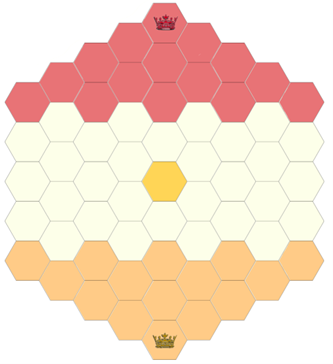
- Players take turns placing all (14) remaining pieces in their Zones of Placement.
- After the final piece is placed, the other player makes the first move of the game.
Player-1 Zone
Player-2 Zone
3-Player Setup
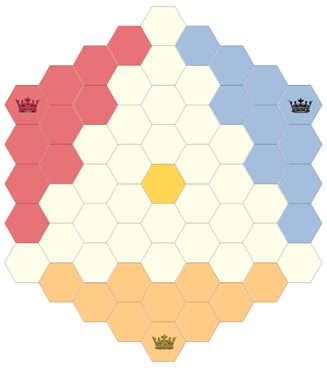
- Players move clockwise as they place all (9) remaining pieces in their Zones.
- After the final pieces is placed, the next clockwise player makes the first move of the game.
Player-1 Zone
Player-2 Zone
Player-3 Zone
Shieldmen
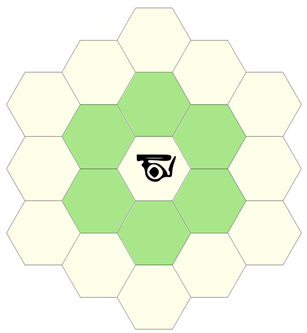
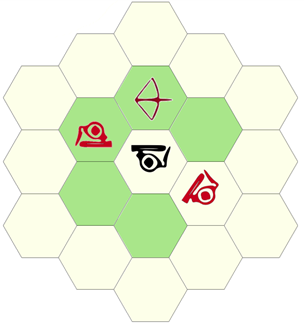
- Shieldmen can move one tile in any direction.
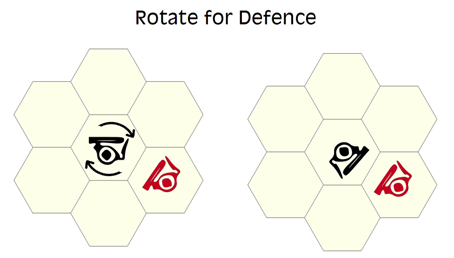
- Rotate any or all Shieldmen before moving.
- Shieldmen can Move or Capture.
- Shieldmen can land in any rotated position when moving.
- Shieldmen are impervious to attack from the direction they are facing.
Tactical Maneuver: Rotate for Defence at the start of your turn.
Archers
- Archers can move one tile in any direction.
- Archers can move or shoot, not both.
- Archers cannot capture, but shooting an opponent removes it from the board.
- Archers can move one space in any direction into any unoccupied tile.
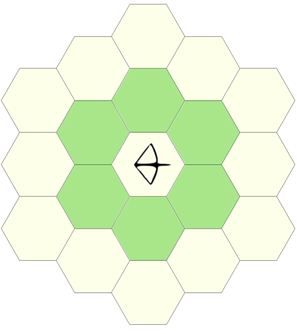
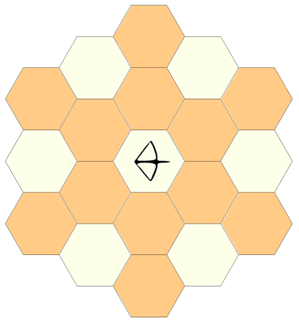
- Archers can only shoot in a straight line, one or two tiles away.
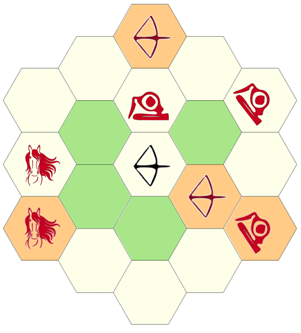
- Archers can shoot over the top of other pieces, striking an enemy.
- Archers cannot shoot a shieldman who is facing them.
Horsemen & Warlords
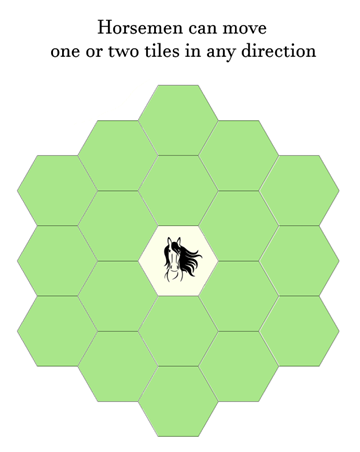
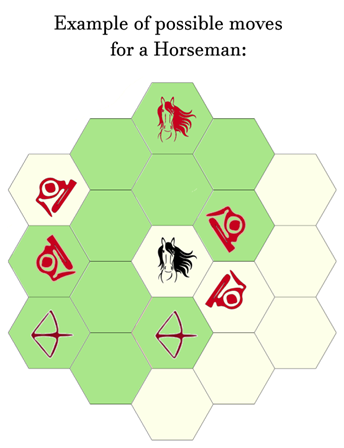
- Horsemen can move one or two tiles in any direction.
- Horsemen Move or Capture.
- The Warlord moves and captures like a horseman.
- Horsemen capture enemy pieces by moving into their space.
- Horsemen can’t jump pieces or move back to the same tile in one turn.
The Warlord
- The Warlord is the most important piece in the game.
- You can only win by eliminating your opponents Warlord, or by reaching / holding the Gold Tile with your Warlord.
Game Components
- Pieces: Three sets have been included for your selection. Each set is comprised of 15 pieces, which includes 5 Shieldmen, 5 Archers, 4 Horsemen, and 1 Warlord.
- Board: The board features sixty-one hexagonal tiles. The colors of the tiles are not important to game play, except for the central Gold tile which is an important part of winning the game.
2-Player Game Rules
Setup
- Players start with their Warlords at opposite corners.
- The starting player, Player-1, is randomly selected.
- Each player takes turns placing their pieces on the board, in a configuration of their choice, within their designated starting areas. (See Moves Manual)
- Player-1 will place a piece, then Player-2 will place a piece. This continues back and forth until all pieces have been placed.
1. Turn Structure
- After Player-2 places the final piece, Player-1 will make the first move. Players will take turns moving their pieces.
- During a turn, a player can first perform unlimited rotations, and then must perform one of the following actions as detailed below: Move, Shoot, or Capture. This ends their turn.
- A player must move, shoot, or capture even if that results in them moving into danger.
- If a player is physically unable to perform one of these actions their turn ends after they have had a chance to perform any rotations.
2. Rotation
- At the beginning of each turn, any number of Shieldmen can be rotated for defence, facing any of the six directions. The player’s turn continues.
- The Shieldmen are impervious to attack from the direction they are facing. This means Archers cannot shoot Shieldmen facing their direction, and they cannot be captured from the direction they are facing (unless a Horseman side-steps first).
- Shieldmen can land in any rotated position.
3. Movement
- Players may move one piece per turn unless they choose to shoot instead.
- Archers and Shieldmen can move one space in any direction.
- Horsemen and Warlords can move one or two spaces in any direction. Moving ends a player’s turn.
- No piece can move through or over an occupied tile. Horsemen and Warlords may not “jump over” occupied tiles.
- They also may not move one tile and then return to their original tile in the same turn.
- Only one piece can occupy a tile. Moving into an occupied space is not allowed, unless you are capturing an enemy piece.
4. Capture
- Shieldmen, Horsemen, and Warlords may capture an opponent’s piece by moving onto their tile. The captured piece is removed from the game.
- Archers cannot capture.
- Shieldmen are impervious to capture in the direction they are facing. However, it is possible for a horseman or warlord to sidestep and then capture a shieldman, as horsemen and warlords can move two spaces.
- Capturing ends a player’s turn.
5. Shooting
- Archers can either move or shoot but not both. Shooting ends a player’s turn.
- Archers can shoot one or two tiles away, only in a straight path. (See the Moves Manual)
- Archers do not move from the tile when they shoot – they remain in place.
- Shooting an enemy piece removes it from the board.
- Archers cannot shoot empty tiles or friendly pieces. They may shoot over the top of friendly or enemy pieces.
- Archers cannot shoot Shieldmen facing their direction but can shoot over their heads.
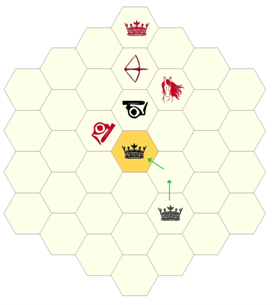
6. The Gold Tile
- The Gold tile can be moved onto and occupied by any piece. The Gold tile is a normal tile until a Warlord moves onto it, in which case one player will win or lose.
7. Winning Conditions
- 1. Eliminating: Capturing or shooting the opponent’s Warlord, which immediately ends the game.
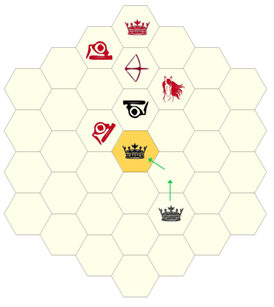
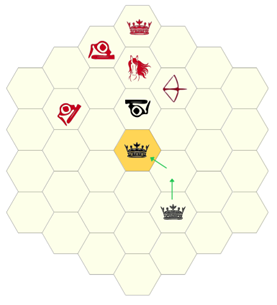
- 2. Conquering: Moving their Warlord onto the central Gold tile and surviving the opponent’s immediate next move.
- 3. Dominating: Moving their Warlord onto the central Gold tile when the opponent has four or less pieces left. This is an automatic win and the opponent does not get a next move in this scenario.
3-Player Game Rules
Note: For a 3-player game, players may decide if discussions are allowed during the game (Verbal Alliances, agreements, commentary, advice, etc.). Any verbal alliance or agreement made during play will not have to be honoured– but the agreed upon discussion rules should be followed.
Setup
- Pieces: For a 3-Player game, only partial armies will be used. Each player will be given 10 pieces – 4 Shieldmen, 3 Archers, 2 Horsemen, and 1 Warlord.
- Players start with their Warlords at three farthest corners.
- The starting player, Player-1, is randomly selected, then the turns move clock-wise.
- Each player takes turns placing their pieces on the board, in a configuration of their choice, within their designated starting areas. (See Moves Manual)
- Player-1 will place a piece, then Player-2 will place a piece, followed by Player-3. This continues until all 10 pieces in the partial sets have been placed.
3-Player Winning Conditions
- Only one player can win. When the first warlord is eliminated, that player’s pieces are immediately removed from the board before the next player’s turn.
- 1. Eliminating: Capturing or shooting the opponent’s Warlord, once only two players remain. This immediately ends the game.
- 2. Conquering: Having their Warlord move onto the central Gold Tile and surviving until their next turn. This means the remaining player(s) will (both) have one more turn in which they can eliminate the warlord on the Gold Tile.
- 3. Dominating: If only two players remain, a player may win by moving onto the Gold tile with their Warlord when the remaining opponent has three or less pieces left.